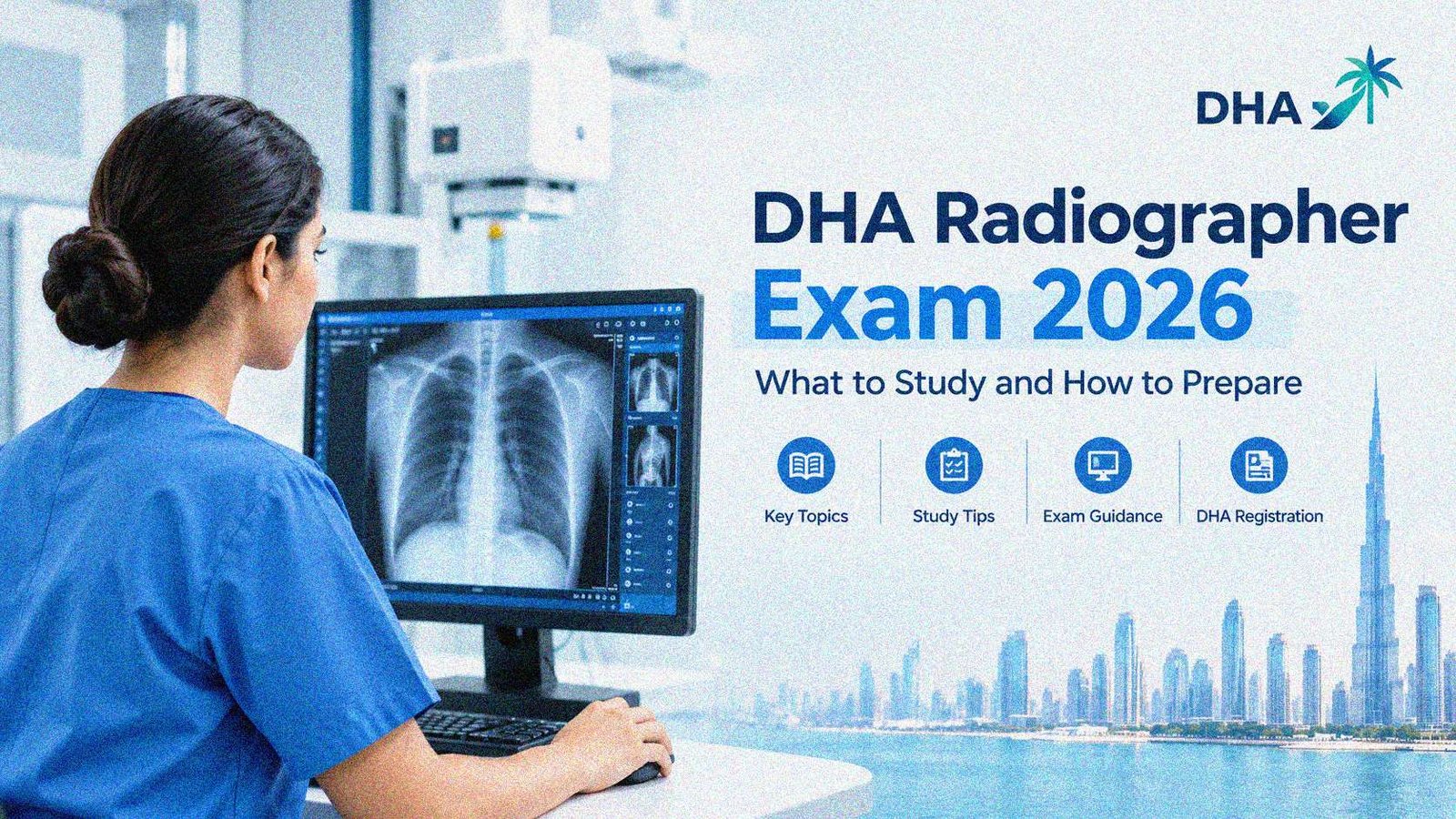
Preparing for the DHA Radiographer Exam 2026 requires more than memorizing radiology terms. You need a strong understanding of imaging techniques, radiation safety, patient care, and clinical procedures. You also need to understand the Dubai Health Authority’s licensing process before applying.
The DHA uses computer-based testing (CBT) through Prometric for applicable assessments. However, the exact assessment method depends on your professional title and DHA requirements. This guide explains what to study, how to organize your preparation, and what to do before applying for DHA registration.
What Is the DHA Radiographer Exam?
The DHA Radiographer Exam is a professional assessment used to evaluate the knowledge and competencies of applicants seeking registration as radiographers in Dubai, when an assessment is required.
The DHA may require a computer-based test or an oral assessment, depending on the professional position. Applicants should check the official DHA assessment guidance for their specific title rather than relying on a general exam format.
The exam forms part of the licensing process. Passing an assessment alone does not provide permission to practice in Dubai.
DHA Radiographer Exam Syllabus 2026: What Should You Study?
The DHA’s official Professional Qualification Requirements (PQR) define professional qualifications and experience, but applicants should consult the relevant DHA exam guideline for the applicable assessment content. The following subjects provide a practical study framework, not a confirmed official exam blueprint.
1. Radiographic Positioning and Imaging Techniques
Review common radiographic examinations and their positioning requirements. Focus on:
- Chest, abdomen, pelvis, and extremity radiography
- Spine and skull projections
- Patient positioning and anatomical landmarks
- Central ray direction, image receptors, and collimation
- Image evaluation and common positioning errors
- Portable and trauma radiography
Practice identifying positioning errors and selecting appropriate projections for different clinical situations.
2. Radiation Physics and Radiation Protection
Understand the principles behind X-ray production and radiation safety. Review:
- X-ray production and interactions with matter
- Exposure factors, including kVp and mAs
- ALARA principles and dose optimization
- Radiation protection for patients and staff
- Dose monitoring and radiation units
- Filtration, collimation, and shielding principles
You should also understand how exposure factors affect image quality and patient dose.
3. Anatomy and Physiology
Revise the anatomy most relevant to diagnostic imaging. Pay particular attention to:
- Musculoskeletal anatomy
- Thoracic and abdominal organs
- Cardiovascular and respiratory systems
- Nervous system and spinal anatomy
- Anatomical planes and directional terminology
Connect anatomical knowledge with the clinical purpose of each radiographic examination.
4. Imaging Equipment and Digital Radiography
Understand how modern imaging equipment works and how radiographers maintain image quality. Study:
- Computed radiography (CR) and digital radiography (DR)
- Image acquisition and processing
- Exposure indicators and image artifacts
- PACS and RIS fundamentals
- Quality control and equipment checks
- Common causes of image degradation
Also review the basic principles of CT, MRI, fluoroscopy, and mammography, according to your professional scope.
5. Patient Care and Clinical Procedures
Patient safety and communication are important parts of professional radiography practice. Revise:
- Patient identification and informed consent
- Infection prevention and control
- Safe patient handling and transfer
- Contrast media safety and adverse reactions
- Emergency response and basic life support principles
- Communication with patients and clinical teams
Focus on practical decisions, especially when working with pediatric, elderly, trauma, and vulnerable patients.
6. Professional Ethics and Quality Assurance
Review the responsibilities of a radiographer in a regulated healthcare setting. Important areas include:
- Patient confidentiality and privacy
- Professional boundaries and accountability
- Incident reporting
- Documentation and clinical communication
- Quality assurance and quality control
- Radiation safety regulations and professional conduct
Use current professional standards and your clinical experience to understand these topics.
How to Prepare for the DHA Radiographer Exam
A structured study plan can help you cover the main areas without unnecessary repetition. Adjust your schedule according to your existing knowledge and the assessment requirements confirmed by DHA.
Step 1: Confirm Your Eligibility
Start with the DHA Self-Assessment Tool in the Sheryan portal. The Unified PQR, published in April 2025, lists the qualifications and experience applicable to each professional title.
UAE Unified Healthcare Professional Qualification Requirements (PQR)
For example, the PQR lists a bachelor’s degree in radiography, radiology technology, or medical imaging, along with two years of post-qualification experience in general radiology, for the Radiographer/Radiography Technologist title. Other accepted qualifications have specific conditions. Always verify the applicable title and requirements against the current PQR.
Step 2: Review the Official Exam Guidance
Check the DHA’s CBT Assessment Guideline and Mode of Exam per Specialty. These resources provide the applicable assessment details, including available information about exam content, duration, questions, and references.
DHA Healthcare Professional Services
Do not assume that another healthcare professional’s exam format applies to your title. DHA does not publish study references for oral assessments, so prepare using relevant professional standards and clinical knowledge. DHA Professional Services
Step 3: Create a Realistic Study Schedule
Divide your preparation into manageable subject areas. For example, you could organize your study as follows:
- First phase: Radiographic positioning, anatomy, and imaging techniques
- Second phase: Radiation physics, protection, and equipment
- Third phase: Patient care, ethics, and quality assurance
- Final phase: Practice questions, weak-topic revision, and mock assessments
Set daily goals based on your availability. Spend additional time on subjects where you struggle to explain clinical decisions.
Step 4: Practice Radiography MCQs
Use relevant practice questions to test your understanding. Choose questions that explain why an answer is correct, rather than relying on memorized answer patterns.
After each practice session, review incorrect answers and revisit the underlying concepts. Focus on clinical scenarios, positioning decisions, radiation protection, and patient safety.
Practice questions are useful learning tools, but they are not confirmed DHA exam questions unless DHA explicitly identifies them as such.
Step 5: Review Clinical Scenarios
Clinical scenarios help you apply theoretical knowledge to real imaging situations. Practice deciding how to position a patient, manage an imaging challenge, or respond to a radiation safety concern.
For example, consider a patient who cannot stand for a routine chest X-ray. Review how to adapt the examination while maintaining patient safety and appropriate image quality.
DHA Registration and Licensing: What Happens After Preparation?
The DHA licensing process involves several separate stages. According to DHA’s professional services guidance, applicants generally follow this pathway:
- Self-assessment: Check your qualifications and eligibility through Sheryan.
- Primary source verification: Complete the required verification of credentials through the designated process, commonly involving DataFlow.
- Assessment: Complete the CBT or oral assessment if DHA requires one for your professional title.
- Get registered: Submit the registration application and obtain DHA approval.
- Activate your license: A DHA-licensed healthcare facility must activate your registration before you can practice.
DHA registration confirms that you meet the requirements for the applied professional title. It is not an active license to practice. DHA states that registration is valid for one year, during which a healthcare facility should activate it into a license.
Common Mistakes to Avoid
Applicants can make avoidable mistakes when preparing for the exam or starting their licensing applications.
- Studying without checking the assessment guidance: Your professional title determines the relevant assessment requirements.
- Memorizing MCQs only: Memorization cannot replace clinical understanding and safe decision-making.
- Confusing registration with licensing: Registration does not authorize independent practice.
- Ignoring document verification: Incomplete or inconsistent credentials can delay the application.
- Assuming experience requirements are identical: Requirements vary by professional title and qualification.
- Using outdated study material: Review the latest official guidance before relying on older exam preparation resources.
DHA’s published guidance also states that applicants must pass the related assessment within three attempts across the UAE authorities. Check the current rules that apply to your application before scheduling an assessment.
Frequently Asked Questions
Is the DHA Radiographer Exam conducted online?
DHA uses Prometric for applicable computer-based tests, which candidates may attend at recognized Prometric centers worldwide. The assessment method depends on the professional title and DHA requirements. Confirm your assigned assessment type through the official DHA guidance.
What is the passing score for the DHA Radiographer Exam?
The applicable passing score should be confirmed through the current DHA CBT Assessment Guideline and Mode of Exam per Specialty. Do not rely on unofficial websites or old preparation materials for a score that may not apply to your assessment.
Can I apply for DHA registration without UAE experience?
UAE experience is not a universal requirement for every radiographer applicant. The PQR sets out the qualification and post-qualification experience requirements for each professional title. DHA evaluates your credentials against the applicable criteria, including accepted experience gained outside the UAE.
Can I work in Dubai immediately after passing the exam?
No. Passing an assessment does not automatically grant an active DHA license. You must complete the applicable registration requirements and have your registration activated by a licensed healthcare facility before practicing.
How many times can I attempt the DHA assessment?
DHA guidance states that the related assessment must be passed within three attempts across the UAE authorities. Check the current DHA assessment rules for your professional title and circumstances before reapplying.
Conclusion
Preparing for the DHA Radiographer Exam 2026 starts with understanding your professional title, eligibility, and assessment requirements. Focus your studies on radiographic techniques, anatomy, radiation protection, equipment, patient care, and professional practice.
Combine a structured study plan with regular MCQ practice and clinical scenario reviews. Also, check the latest DHA guidance throughout your application to ensure you meet the current registration and licensing requirements.
Preparing for your DHA Radiographer Exam? RadiologyLens offers focused exam guidance, radiography MCQs, and preparation resources to help you study with a clear plan and build confidence before your assessment.